Louvered Roof, Pavilion, Screened Porch, or Sunroom: Picking the Right Cover for Your Outdoor Room
Four different ways to cover an outdoor room, and how weather, bugs, and how you actually use the space should decide between them.
September 9, 2026 · 4 min read
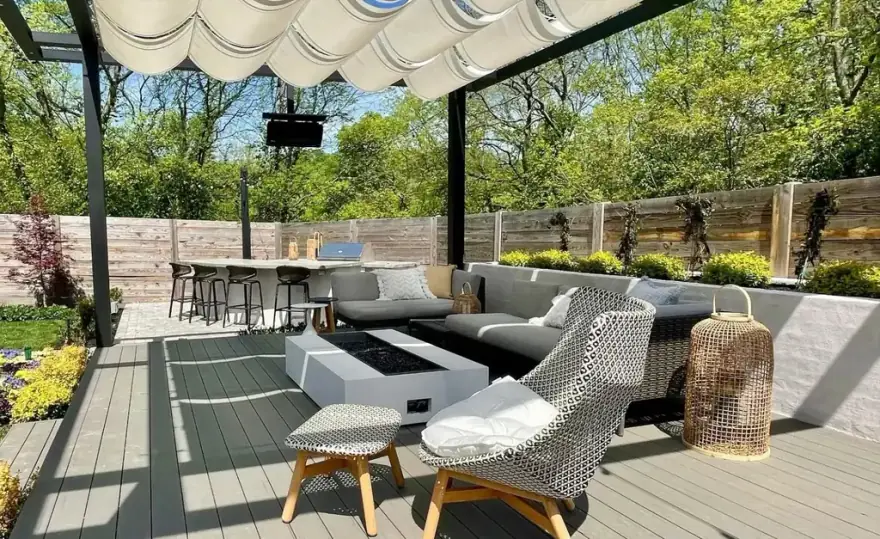
Once a homeowner decides they want a covered outdoor space, the next question is which kind of cover. A motorized louvered roof, a fixed pavilion, a screened-in porch, and a sunroom all solve the same basic problem, protecting the space below from sun and rain, but they solve it in different ways, and the right choice depends on how the space actually gets used through the year, not just how it looks in a photo. Homeowners often start with a name they've seen online, usually the louvered roof, without realizing three other real options exist, each suited to a different way of actually living in the space.
Motorized louvered roofs: control, not commitment
A motorized louvered roof is a structure with adjustable slats that open and close at the push of a button, so the same space can be wide open on a clear evening or fully closed against a sudden afternoon storm. That flexibility is the whole appeal. Instead of choosing between full sun and full shade, the roof adjusts through the day, which matters a lot in Middle Tennessee where a summer afternoon can go from clear to a downpour in twenty minutes. Louvered roofs typically pair well with an outdoor kitchen or a pool deck underneath, since they can open fully to let smoke and steam clear or close to protect furniture and electronics from a sudden shower. Because the roof is motorized rather than fixed, it also introduces moving parts and a control system that a fixed pavilion simply doesn't have, which is worth understanding as part of the tradeoff between flexibility and simplicity.
Pavilions: permanent shade with real structure
A pavilion roof is fixed rather than adjustable, and that's a feature, not a limitation. It's a straightforward, sturdy structure that gives permanent shade and weather protection over a defined area, whether that's an outdoor kitchen, a seating area around a fire feature, or the deck surrounding a pool. Pavilions read as a real architectural extension of the house rather than an add-on, especially with a gable roof or infinity canopy design that carries the home's rooflines out into the yard. If the plan is to use the space the same way every time, cooking, dining, sitting by the fire, a pavilion gets that job done without the added mechanics of a motorized system.
Screened porches: keeping the bugs out without closing the space in
A screened-in porch adds walls of mesh screen to a covered structure, which changes the experience more than people expect. It's still fundamentally an outdoor space, you still feel the breeze and hear the yard, but it removes the two biggest complaints about sitting outside on a Tennessee evening: mosquitoes and pollen. For a family that wants to eat dinner outside regularly rather than as an occasional event, a screened porch tends to get used far more often than an open patio, simply because nobody has to fight bugs to enjoy it.
Sunrooms: the space that works in January too
A sunroom goes a step further, enclosing the space with real windows rather than screen, which means it can be conditioned and used through the colder months when an open porch or pavilion sits empty. It reads more like an extension of the house itself than an outdoor room, useful for a family that wants a bright, plant-filled space to use year-round rather than seasonally. It's also the option with the most in common with an interior renovation, closer in scope to adding a room onto the house than building a backyard structure.
What sits underneath the cover matters as much as the roof
The right choice also depends on what's actually happening under the structure. A pool deck benefits from a louvered roof's ability to open fully for swimming and close fast when a storm rolls in unannounced. An outdoor kitchen does well under either a louvered roof or a pavilion, since both handle smoke and heat without trapping it the way a fully enclosed sunroom would. A dining table that gets used most evenings, rain or shine, points toward a screened porch or sunroom, something that doesn't require anyone to check a forecast before deciding to eat outside. Thinking about the roof and what's underneath together, rather than choosing the cover first and figuring out the layout after, tends to produce a space that actually gets used the way it was designed to be used.
Choosing between them
In practice, the decision usually comes down to how the space gets used and what's underneath it. A louvered roof over a pool deck or outdoor kitchen earns its keep by adapting to weather nobody can predict. A pavilion suits a family that wants dependable shade without moving parts. A screened porch is the answer for anyone who loves eating outside but hates swatting mosquitoes. A sunroom is for the household that wants a genuinely year-round room. Allin Landscaping builds all four as part of complete outdoor living environments, structures, kitchens, fireplaces, fire pits, lighting, and landscaping designed as one cohesive project, for homeowners across Nashville, Brentwood, Franklin, and Williamson County.
Allin Landscaping, (615) 351-5776
Call (615) 351-5776More articles
Gunite or Fiberglass: Choosing a Pool Shell That Fits Your Nashville Backyard
Two proven ways to build a pool, and how the decision actually plays out on a Middle Tennessee lot.
Where the Pool Actually Goes: How Siting Gets Decided on a Real Brentwood Lot
Pool placement looks simple on a rendering and gets complicated the moment a crew walks the actual yard.