Fire Pit or Outdoor Fireplace: How Each One Changes Where the Seating Goes
The choice between a fire pit and an outdoor fireplace is really a choice about how people will sit around it.
September 9, 2026 · 4 min read
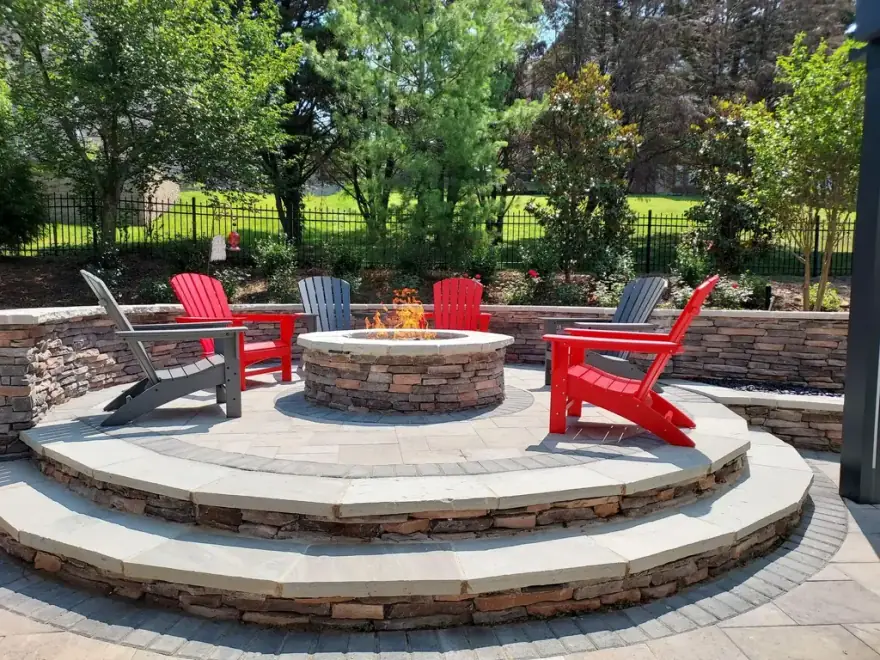
A fire feature is one of the most-used parts of almost every backyard we build, and the choice between a fire pit and an outdoor fireplace changes more than the flame itself. It changes where the seating goes, how many people can gather comfortably, and whether the space feels like the center of the yard or more like a backdrop to it. It's often the single feature that decides whether people linger in the yard after dark or head back inside once dinner's done.
Fire pits: seating that wraps all the way around
A fire pit, whether it's a raised circular stone pit or a modern square fire table, sits low and puts the flame at the center of a room the seating builds around it. Because you can see and talk to everyone across the fire, a circle or near-circle of chairs, often something like an Adirondack chair ring, works naturally. That layout is genuinely social: nobody has their back to the group, and the fire itself becomes the thing everyone is gathered around rather than gathered near. It also tends to work well in an open lawn or patio area where the seating can be arranged loosely and moved around for a bigger group.
Outdoor fireplaces: a wall the seating faces
An outdoor fireplace works differently because the flame sits inside a vertical structure, stone or brick masonry built up from the ground, so it reads more like the fireplace in a living room than a campfire. Seating naturally lines up facing the fireplace rather than surrounding it, which makes it a strong anchor for a defined outdoor room, especially one with a pavilion or covered roof overhead. An outdoor fireplace also throws heat differently than a pit, radiating forward rather than up and out in every direction, so it can extend how late in the year a covered patio gets used. That difference is worth thinking through early, since it affects how far the seating sits from the structure and how much open lawn is left around it.
What the masonry actually does for the space
Both fire pits and outdoor fireplaces come down to real stone and brick masonry work, and that masonry is doing double duty. It's containing the fire safely, and it's also a permanent design element that ties into the rest of the hardscape, matching or complementing the stone used on a nearby patio or the same paver collection used elsewhere in the yard. A well-built fireplace or pit should look like it was always part of the property, not like a feature that got dropped in afterward. That same masonry, chimney height, hearth depth, and how the structure vents smoke, is exactly the kind of detail that separates a fireplace built to last from one that smokes out the seating area on a still evening.
Gas or wood: another decision the flame itself raises
Both fire pits and outdoor fireplaces can run on gas or burn real wood, and that choice shapes the experience almost as much as the shape of the feature itself. A gas fire lights instantly, burns clean without smoke drifting into a seating area, and gives consistent flame height night after night, which suits a family that wants the fire ready the moment they walk outside. A wood-burning fire pit or fireplace brings the smell of real smoke, the sound of a fire actually crackling, and a slower ritual of building and tending the flame, which some homeowners consider part of the point. Neither is more correct than the other, it comes down to whether the fire is meant to be effortless or is meant to be part of the evening itself.
Lighting and landscaping around the fire
Neither a fire pit nor a fireplace works in isolation. The lighting around it matters just as much once the sun goes down, low path lighting leading guests to the seating, uplighting on nearby trees or the fireplace structure itself, enough ambient light to move around safely without washing out the fire as the actual light source. The planting around a fire feature also does real work, screening the seating area for privacy and softening the hardscape so the space doesn't read as just stone and furniture.
Picking between the two
If the goal is a flexible, social gathering spot that works for a big group and can shift with the occasion, a fire pit usually wins. If the goal is a defined, architectural anchor for a covered outdoor room, something that reads as permanent as the fireplace inside the house, an outdoor fireplace is the better fit. Plenty of backyards genuinely have room for both. A pit near the pool deck and a fireplace anchoring a covered dining area, for instance, give a single backyard two distinct gathering spots instead of one. Allin Landscaping designs fire features as part of the full backyard project, seating, lighting, and landscaping coordinated together, for homeowners across greater metro Nashville, Brentwood, and Franklin.
Allin Landscaping, (615) 351-5776
Call (615) 351-5776More articles
Gunite or Fiberglass: Choosing a Pool Shell That Fits Your Nashville Backyard
Two proven ways to build a pool, and how the decision actually plays out on a Middle Tennessee lot.
Where the Pool Actually Goes: How Siting Gets Decided on a Real Brentwood Lot
Pool placement looks simple on a rendering and gets complicated the moment a crew walks the actual yard.